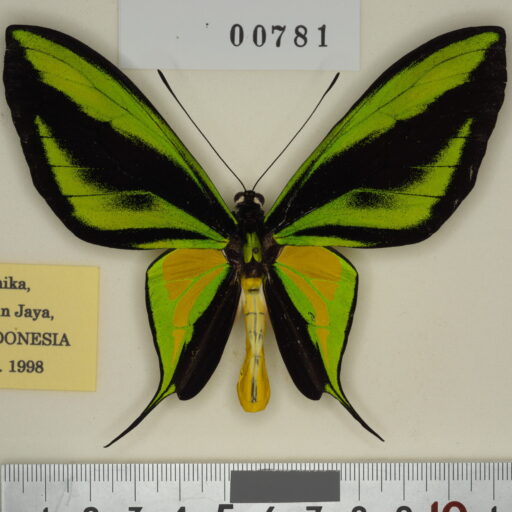
Report on New Taxa (2026. 1)
Deslisle, G. (2026): Birdwing Butterflies NOVA, Part I (Lepidoptera, Papilionidae, Troidini)
Faunitaxys, 14 (03), 2026: 1-51.
https://doi.org/10.57800/faunitaxys-14(03)
Contents: New Taxa from Indonesia
- Troides (T.) helena usmani nov. and karamianensis ♀-f. nov. (Karamian Is.)
- Troides (T.) helena helena Linnaeus, 1758, ♀-f. dea (Bali Is. and Java Is.)
- Troides (T.) criton criton Felder, 1868 (a new locality – Kayoa Is.)
- Ornithoptera (Sch.) paradisea arfakensis f. loc. orientalis Dufek & Schäffler, 2006 and O. (Sch.) paradisea arfakensis f. loc. kotaseaoe Dufek & Schäffler, 2006 (descriptions of two unknown ♀♀)
- Ornithoptera (O.) croesus croesus f. loc. nobesi nov. and ♂-f. olivaceus nov. (Kayoa Is.)
- Ornithoptera (O.) croesus croesus f. loc. laantoni nov. (Muari Is.)
- Ornithoptera (O.) priamus hecuba f. loc. watubelaensis nov. (Watubela Is.)
- Ornithoptera (O.) priamus poseidon f. loc. aureus Parrott, 1987, ♀-f. madrinneae nov. (Arfak Mts., Irian Jaya)
Summary:
1.Troides (T.) helena usmani Deslisle, 2026 and ♀-f. karamianensis Deslisle, 2026
(Distribution)
INDONESIA [E. Java] Karamian(Karamai)Island(An islet just south of S. Kalimantan, Bawean Is. lies to the southwest and Kangean Is. to the southeast, both about 240 Km away.)
(Episodes on discovery and original description)
It was described based on 25 ♂♂, 16♀♀specimens discovered and collected by Ode Usman in March 2019.
(Characteristics)
The Karamian Island population is possibly at the origin of those on Kangean Island (ssp. antileuca) and Bawean Island (ssp. nereides), which is limited respectively a single dark female form and a single light female form.
(Spotted pattern)
♂: It differs from ssp. antileuca, which by the absence of pale streaks on veins and the presence, on most, of a black spot in space 6, generally not confluent with the based spot and it also differs from ssp. nereides, which generally has a more or less complete series of discal black spots on HW.
♀: There are two forms: a dark form and a light form (♀-f. karamianensis Deslisle, 2026). In ssp. nereides from Bawean Is., the pale band of HW is a distinctive dirty gray-yellow color, whereas in this ssp. is yellow color.
2. Troides (T.) helena helena Linnaeus, 1758, ♀-f. dea Deslisle, 2026
Extreme form of ♀-light form from Java and Bali Islands, INDONESIA, which is equivalent to♀-f. hycetus (Rippon, 1906)(=♀-f. albicans (Roepke, 1935)).
3. Troides (T.) criton criton Felder, 1860
(Distribution)
INDONESIA [Maluku] Kayoa Island (A small island in the Molucca Sea, located slightly southeast of the central part of Halmahera Is.) – Reported as a new location. (Note: This entry has already been included in this digital encyclopedia.)
4a. Ornithoptera (Sch.) paradisea arfakensis f. loc. orientalis Dufek & Schäffler, 2006
First report of a female specimen collected on Onin Peninsula (Fak Fak), Irian Jaya, INDONESIA, the habitat of this local form.
The HW is broader, more rounded and the dark marginal band is markedly wider than those of ssp. arfakensis, it can be said that this specimen possesses sufficient distinguishing characteristics to be classified as a local form. In this digital encyclopedia, it is classified as O. (S.) arfakensis (?) orientalis Dufek & Schäffler, 2006.
4b. Ornithoptera (Sch.) paradisea paradisea f. loc. kotaseaoe Dufek & Schäffler, 2006
First report of a female specimen collected on Wandamen Mts. (Northeast Wondiboi Mts.), Irian Jaya, INDONESIA, the habitat of this local form.
Actually, regarding the photograph of this female specimen, Mr. Deslisle – the author of this paper – and Ohya had discussed it prior to the paper’s publication. The pale band on HW of the specimen presented here is milky white, whereas the specimen (081-00780) of Ohya’s collection, which was included in this digital encyclopedia, is yellow. It appears that further examination of additional specimens will be necessary to reach a conclusion.
In this digital encyclopedia, it is classified as O. (S.) paradisea chrysanthemum f. loc. (?) kotaseaoe Dufek & Schäffler, 2006.
5. Ornithoptera (O.) croesus croesus f. loc. nobesi Deslisle, 2026 and ♂-f. olivaceus Deslisle, 2026
(Distribution)
INDONESIA [Maluku] Kayoa Is.
(Episodes on discovery and original description)
It was described based on 29♂♂, 20♀♀specimens discovered and collected by La Anton between April and May 2017.
(Characteristics)
Although this local form is found in the northernmost area of its range, its spotted pattern most closely resembles those of f. loc. wallacei, which is found in the southernmost area. At species level, f. loc. nobesi nov. is closer to ssp. c. lydius.
(Spotted pattern)
♂ : Radial band of FW is broad and running around the cell apex to the base of space 4.
♀:Pale subapical cell spot always present. (distinctive feature)
(Variation)
♂-f. olivaceus Deslisle, 2026: [FW/HW discoloration] Both sides of FW/HW are deeply covered with olive-green scales.
6.Ornithoptera (O.) croesus croesus f. loc. laantoni Deslisle, 2026
(Distribution)
INDONESIA [Maluku] Muari Is. (A small island located just about 4 Km north of Kasiruta Is.)
(Episodes on discovery and original description)
It was described based on 10♂♂, 5♀♀ specimens discovered and collected by La Anton, a local breeder, between April and May 2023.
(Characteristics)
Markings are covered in a more extensive metallic green coloration in males. The pale patches are smaller in females.
(Spotted pattern)
♂: Stands out by the predominance of a metallic bicolor orange and green, as well as by constant shape of the radial band. The patches of underside are slightly shaded by olive-green scales.
♀: The pale spots of FW and HW are reduced or absent, so the entire area appears dark.
7. Ornithoptera (O.) priamus hecuba f. loc. watubelaensis Deslisle, 2026
(Distribution)
INDONESIA [Maluku] Watubela (Matabela) Is. (A small island located about 4 Km south-east of Kasiui Is. (about 1 x 2 Km)).
(Episodes on discovery and original description)
It was described based on 10♂♂, 10♀♀ specimens discovered and collected by La Anton, a local breeder, in January 2022.
(Characteristics)
This local form is first discovered on Watubela Is., a previously unknown area of its extensive range (Kai Islands – Tayandu Islands – Watubela Islands).
(Spotted pattern)
♂: The bright blue and metallic green of the underside of both FW/HW is prominent.
♀: The pale spots of FW/HW are reduced. The yellow cubital vein of HW underside present for the majority females is remarkable as it represents a new character in Birdwing.
8. Ornithoptera (O.) priamus poseidon f. loc. aureus Parrott, 1987 ♀-f. madrinneae Deslisle, 2026
Color discoloration in the markings of the female from the Arfak Mts, Irian Jaya, INDONESIA.
Closer to f. michikoae Sumiyoshi, 1989 characterized by all the spots turns yellow and some with green metallic scales, f. madrinneae Deslisle, 2026 distinguished by the absence of green metallic scales. Note that in this digital encyclopedia, it is classified as O. (O.) priamus poseidon Doubleday, 1847.