







プレスリリース Press Release (English follows Japanese)
進化生物学最大の謎「性の2倍のコスト」に答えが得られた
Answer Found to the Greatest Mystery in Evolutionary Biology: “The Twofold Cost of Sex”
原著論文:
Yukio Yasui, Double-income anisogamy offsets the twofold cost of sex by resource defense. Journal of Ethology. March 18, 2026. DOI: 10.1007/s10164-026-00885-9
https://link.springer.com/article/10.1007/s10164-026-00885-9
安井 行雄「資源防衛によって性の2倍のコストを相殺する二重収入アニソガミー」
ほとんどの多細胞生物はアニソガミーanisogamyという、大きな卵を小さな精子が受精する形の有性生殖を行います。これは同時に卵を作る雌と精子を作る雄に性別が二極化していることを意味します。なぜ雄と雌がいるのか、これは古代ギリシアの哲人アリストテレス以来二千年にわたる人類の疑問とされてきました。(なお本稿で用いる「雄」「雌」「性別」などの用語は、生物学における配偶子の性質に基づく生物学的性(sex)を指す学術用語であり、人間社会における性自認・社会的役割・文化的概念としてのジェンダー(gender)や個人のあり方を示すものではありません。また、本稿中の人間社会への言及や比喩は理解を助けるための説明上の表現であり、特定の家族形態・社会制度・価値観を評価または規範化する意図はありません。)
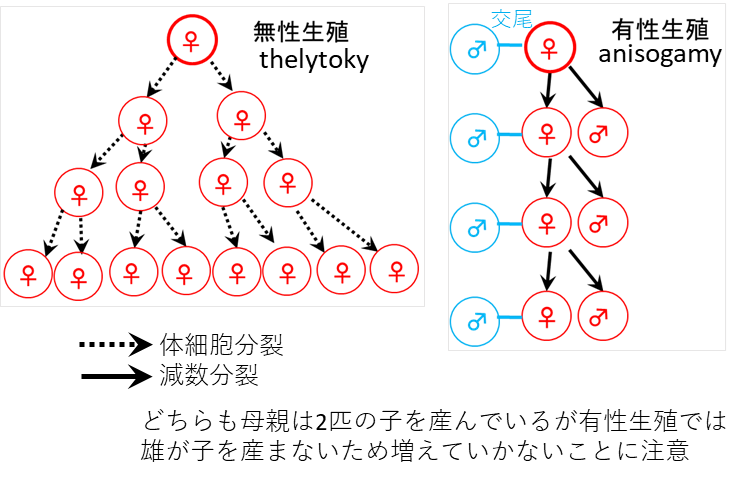
アニソガミーでは、母親が生む子の半数は、自分自身では子を産まない雄となります。もしアニソガミー集団に、突然変異で雌のみを生む無性生殖セリトキーthelytoky雌が生じた場合、増殖率がアニソガミーの2倍になるため数世代で有性個体群を置き換えると予想されます。有性生殖が負っているこの圧倒的不利を「性の2倍のコストtwofold cost of sex」または「雄を作るコストmale production cost」と呼び、このような不利にもかかわらず、ほとんどの種に雄が維持されている事実は、進化生物学における最大の謎の一つです。20世紀以降、Herman J. Muller、John Maynard-Smith、Geoffrey A. Parker、William D. Hamilton等、数々の天才がこの難問に挑みましたがその説明は不十分です。農学部の安井行雄教授は長年この問題に取り組み、2022年には「配偶子有性生殖とアニソガミーの起源」論文(https://link.springer.com/article/10.1007/s10164-022-00760-3)で世界を驚かせましたが、この度、「なぜコストのかかる雄が維持されているのか」という究極の難問を説明する新理論を発表しました。
「性の2倍のコスト」を論じるうえで重要なのは、セリトキーとアニソガミーの個体群増加率の差は毎世代2倍であるため、10世代後には個体数の差は210 = 1024倍に累積される点です。このことはアニソガミーがセリトキーに対抗しようとすれば、雄が毎世代2倍の利益をもたらさなければ採算が合わないことを意味します。したがって雄から来ると期待される利益は後の世代に遅れて戻ってくるような「遺伝的利益」ではとても間に合いません。たとえば現在有性生殖の利益として定番理論となっている「赤の女王」仮説では、雄が雌とは異なる遺伝子を持ち、交配によって新たな適応的遺伝子型(病原抵抗性など)が生み出されると想定していますが、性自体は新たな突然変異を生み出すわけではなくその組み合わせをランダムに変えているだけなので、環境が刻々変化して優勢な病原体の種類も世代間で移り変わるとき、それにうまく対応できる遺伝子型を毎世代作り続けることなど不可能です。アニソガミー集団をセリトキー突然変異体の侵入から守るためには後者が生じたその都度、それを殺さなければなりません。雄由来の「2倍の利益」がなければアニソガミーはセリトキーに勝てず、競争が次世代に持ち越されると、セリトキーの個体数は2倍になり、勝つことはさらに難しくなります。したがって雄からもたらされるのは、その世代(交尾した雌自身)において適応度(生存する娘の数)を即座に2倍に高める(セリトキーと同等にする)ような物質的利益でなければならないということになります。
しかし多くの動物において雄はもっぱら交尾回数を増やすことに精力を注ぎ、雌に餌を与えたり、子の世話をする種は限定的です(鳥や人間はむしろ例外)。しかし雄が繁殖戦略の一環として雌や子供にとって重要な資源を守ることresource defenseは広範に見られます。従来、「雄の2倍のコスト」問題とは無関係であるとみられてきた「雄による資源防衛」を安井教授は理論的に結びつけました。雄は豊富な食料源や安全な繁殖地を確保し、交尾を受け入れる有性雌にのみこれらの資源へのアクセスを許します。一方、無性雌は交尾を受け入れないので雄に排除され資源を得ることはできません。その結果、無性雌は自己獲得資源のみに基づく「シングルインカム」状態(これを安井教授は「独身の2倍のコスト」と呼んだ)に対して、有性雌は自己資源に雄提供資源を加えた「ダブルインカム」状態になります。雄確保資源が100%無駄なく雌に利用されることはないにしても、もし雌が追加資源を追加の卵生産ではなく、既存の卵の生存率向上に使うのなら、適応度(生き残る娘の数)をセリトキーと対等以上にすることが可能です。数理モデルとシミュレーションはこのメカニズムが「性の2倍のコスト」を実際に克服できることを示しています。
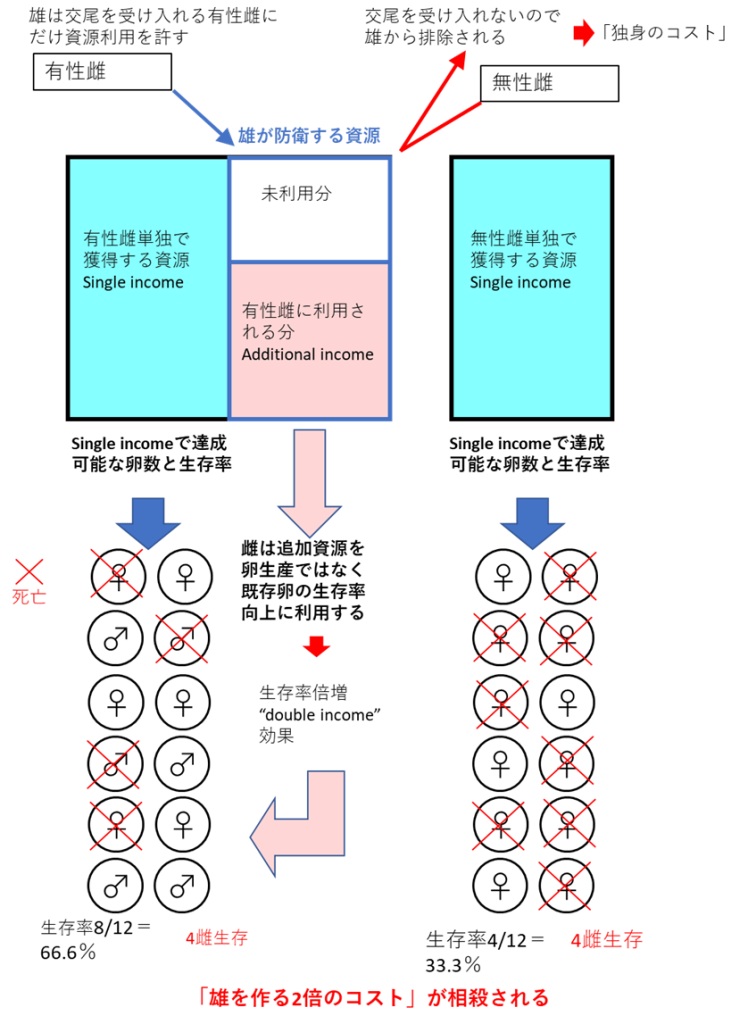
この仮説は誰にとっても理解できるほど単純で直感的です。一般に、両親での子育ては片親での子育てよりも成功確率が高いことが知られています。自然界でも、昆虫から魚類、両生類、鳥類、哺乳類、ヒトに至る多くの種で雄による資源防衛と雌の繁殖成功の間に関係があることが示されています。この研究に刺激されて実証研究が進み、たとえ雄が直接パートナーに餌を与えない場合でも、貴重な縄張りを守ることで母親と子に大きな利点をもたらしている報告例がさらに増えると期待されます。
本論文に加え、「雄がなぜ維持されるのか」の問題を減数分裂の機械的制約から説明する第3論文もまもなく公表見込み(公表後に本サイトに掲載予定)となっていて、この「性の進化3部作」によって進化生物学最大の謎は解決に向かうこととなります。
安井教授は「これらの仮説は不完全なメカニズムであり、不完全だからこそ理にかなった説明となる」と述べています。もしダブルインカムと減数分裂の制約が完全にセリトキーの侵入を阻止できるのであれば、セリトキーの種は存在しないことになります。これらの障壁を突破できたものがいるからこそ少数派ながらセリトキーの種は実在し、雄を作らない2倍の有利性によって短期的には繁栄するが遺伝的多様性を失うため(ここで「赤の女王」等の従来仮説が重要となる)、中長期的には絶滅に向かい、大半の多細胞動物は雄と雌を持ち、一部に雌だけの種がいるという自然界の現状が説明されることになるのです。最後に安井教授は述べています。「進化生物学の定説では、雄は雌に対する寄生者であると考えられてきた。しかし寄生者が寄主と同数存在するシステムがはたして安定でいられるだろうか。雄は雌を通じてしか繁殖できないので雌に協力せざるを得ない。たとえ共進化の過程で一時的に対立関係が生じるとしても究極的には雄と雌は相利共生関係にあるのである。」
Answer Found to the Greatest Mystery in Evolutionary Biology: “The Twofold Cost of Sex”
Original Paper:
Yukio Yasui, Double-income anisogamy offsets the twofold cost of sex by resource defense. Journal of Ethology. 44:189–206. March 18, 2026. DOI: 10.1007/s10164-026-00885-9 https://link.springer.com/article/10.1007/s10164-026-00885-9
Most multicellular organisms reproduce sexually through a process called anisogamy, in which large eggs are fertilized by small sperm. This implies that sex is polarized into males, who produce sperm, and females, who produce eggs. Why there are males and females has been a question that has puzzled humanity for two thousand years, ever since the ancient Greek philosopher Aristotle. (Note that terms such as “male,” “female,” and “sex” used in this document refer to biological sex—a scientific term based on the characteristics of gametes in biology—and do not refer to gender as a concept of sexual identity, social roles, or cultural perspectives within human society, nor do they describe an individual’s personal identity. Furthermore, references to human society and metaphors used in this document are for illustrative purposes to aid understanding and are not intended to evaluate or standardize specific family structures, social systems, or values.)
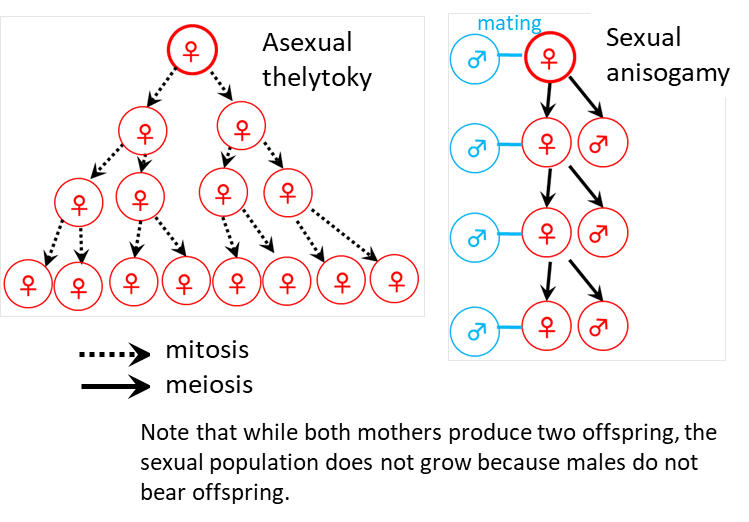
In anisogamy, half of the offspring produced by a mother are males, who do not reproduce themselves. If an asexual thelytoky female—one that produces only females due to a mutation—were to arise in an anisogamous population, her reproduction rate would be twofold compared to anisogamy, so it is expected that she would replace the sexual population within a few generations. This overwhelming disadvantage associated with sexual reproduction is referred to as the “twofold cost of sex” or the “cost of producing males.” The fact that males are maintained in most species despite the disadvantage is one of the greatest mysteries in evolutionary biology. Since the 20th century, numerous geniuses—including Herman J. Muller, John Maynard-Smith, Geoffrey A. Parker, and William D. Hamilton—have tackled this difficult problem, but their explanations remain incomplete. Professor Dr. Yukio Yasui of the Faculty of Agriculture, Kagawa University, Japan has been working on this problem for many years. In 2022, he astonished the world with his paper “The origination events of gametic sexual reproduction and anisogamy” (https://link.springer.com/article/10.1007/s10164-022-00760-3), and now he has presented a new theory explaining the ultimate puzzle: “Why are costly males maintained?”
An important point in discussing the “twofold cost of sex” is that, because the difference in population growth rates between thelytoky and anisogamy is twofold per generation, the difference in population size accumulates to 210 = 1,024 times after 10 generations. This means that for anisogamy to compete with thelytoky, males must provide twofold benefit per generation for it to be worth the cost. Consequently, the benefits expected from males cannot possibly be met by “genetic benefits” that return only in later generations. For example, the “Red Queen” hypothesis—which is currently a standard theory regarding the benefits of sexual reproduction— assumes that males carry different genes from females and that mating produces new adaptive genotypes (such as pathogen resistance). However, because sex itself does not generate new mutations but merely randomly recombines existing ones, it is impossible to continue producing genotypes capable of successfully adapting to the environment when it changes moment by moment and the dominant pathogen types shift from generation to generation. To protect an anisogamous population from the invasion of thelytokous mutants, the latter must be eliminated each time they arise. Without the “twofold benefit” derived from males, anisogamy cannot prevail over thelytoky; if the competition carries over to the next generation, the thelytoky population will double, making victory even more difficult. Therefore, what the male must provide is a material benefit that immediately achieves a twofold increase in fitness (number of surviving daughters) in that generation (for the mated female herself), equalling that of thelytoky.
However, in many animal species, males devote their energy almost exclusively to increasing the frequency of mating, and only a limited number of species involve males in feeding females or caring for offspring (birds and humans are, in fact, exceptions). Nevertheless, “resource defense”—where males protect resources that are important to females and offspring as part of their reproductive strategy—is widely observed. Professor Yasui has theoretically linked “male resource defense”—which was previously considered unrelated to the “twofold cost of males” problem—to this phenomenon. Males secure abundant food sources and safe breeding sites, granting access to these resources only to sexually receptive females. On the other hand, asexual females do not accept mating and are therefore excluded by males, thus unable to obtain resources. As a result, while asexual females remain in a “single-income” state based solely on resources they acquire themselves (which Professor Yasui termed the “twofold cost of being single”), sexual females enter a “double-income” state that combines their own resources with those provided by males. Even if the resources secured by males are not utilized by females 100% efficiently, if females use the additional resources to improve the survival rate of existing eggs rather than for additional egg production, they can achieve a fitness (number of surviving daughters) equal to or greater than that of thelytoky. Mathematical models and simulations demonstrate that this mechanism can actually overcome the “twofold cost of sex.”
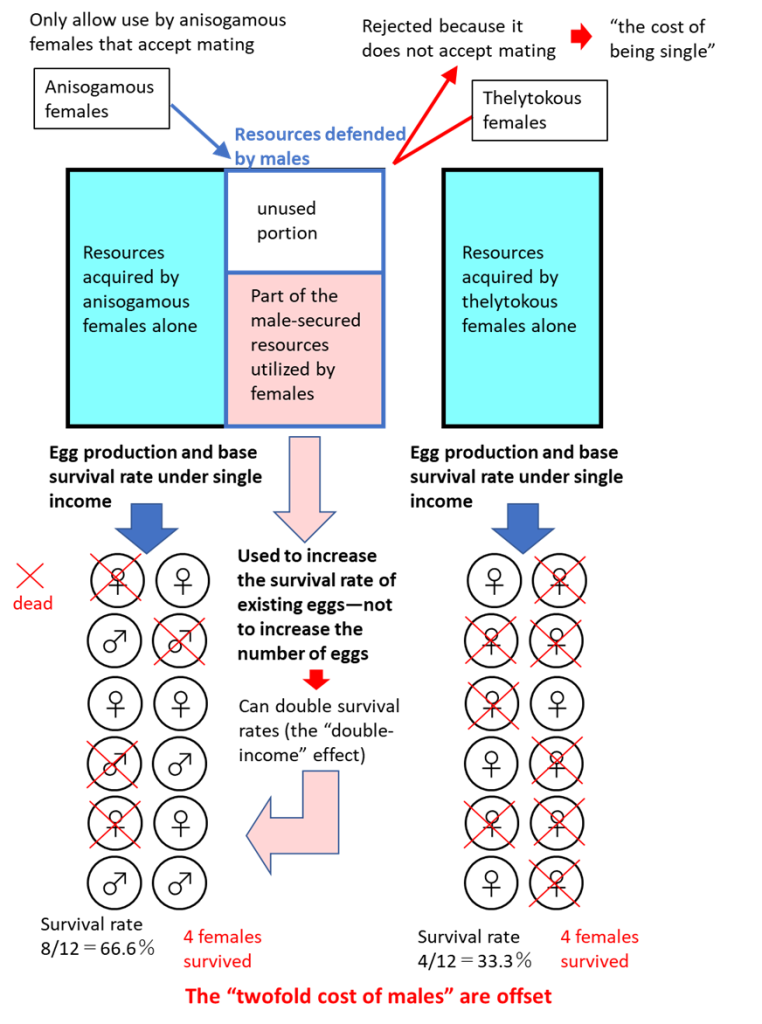
This hypothesis is simple and intuitive enough for anyone to understand. It is generally known that offspring survival is greater under biparental care than under uniparental care. In the natural world, too, a relationship has been demonstrated between resource defense by males and reproductive success in females across many species, ranging from insects to fish, amphibians, birds, mammals, and humans. Inspired by this research, empirical studies are advancing, and it is expected that there will be an increase in reports showing that even when males do not directly provide food to their partners, they still confer significant benefits on mothers and offspring by defending valuable territories.
In addition to this paper, a third paper explaining why males persist based on the mechanical constraints of meiosis is expected to be published shortly (and will be posted on this site once published); with this “Trilogy on the Evolution of Sex,” one of the greatest mysteries in evolutionary biology will be on the verge of being solved.
Professor Yasui states, “These hypotheses represent incomplete mechanisms, and it is precisely because they are incomplete that they provide a plausible explanation.” If the double-income and meiotic constraints were capable of completely preventing the invasion of thelytoky, then thelytokous species would not exist. It is precisely because some species have managed to overcome these barriers that thelytoky species—though a minority—actually exist. Although they prosper in the short term due to the twofold advantage of not producing males, they lose genetic diversity (which is where conventional hypotheses such as the “Red Queen” theory become important). Consequently, they face extinction in the medium to long term. This explains the current state of nature, where most multicellular animals possess both males and females, while a small number of species consist solely of females. Finally, Professor Yasui states: “In traditional evolutionary biology, males have been considered parasites of females. However, can a system in which the number of parasites equals that of the hosts truly remain evolutionarily stable? Because males can reproduce only through females, they have no choice to cooperate with them. Even if a temporary antagonistic relationship arises during the process of coevolution, ultimately, males and females exist in a mutually beneficial symbiotic relationship.”
このページの管理者:農学部広報担当